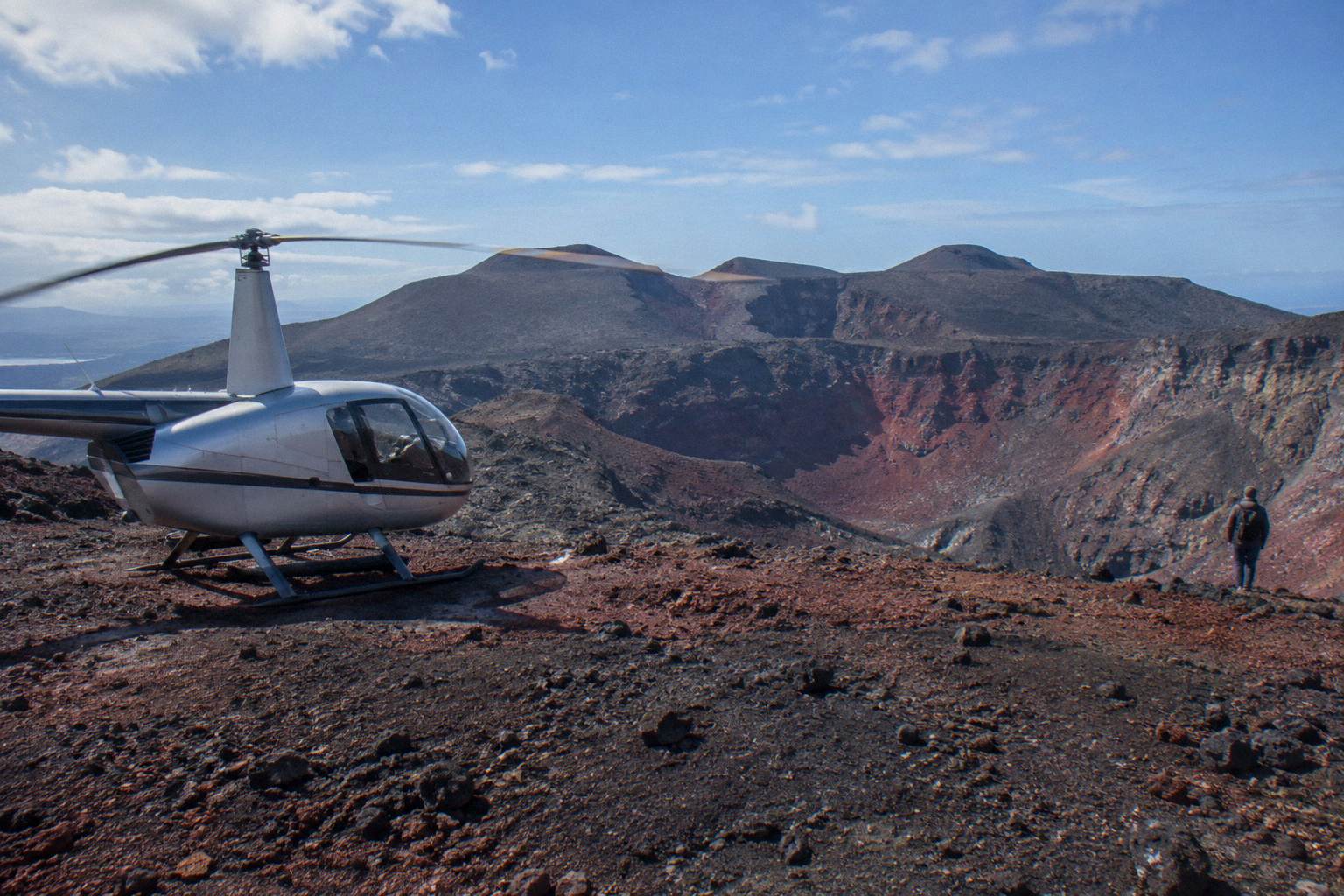
Mt Tarawera Helicopter Tour With A Summit Landing
A helicopter flight from the Rotorua lakefront crosses three lakes, lands on the summit of Mt Tarawera and gives a short guided walk on the crater rim, all in about 40 minutes. Here is how the landing options compare, what the rules are and what happens when weather says no.
Short answer
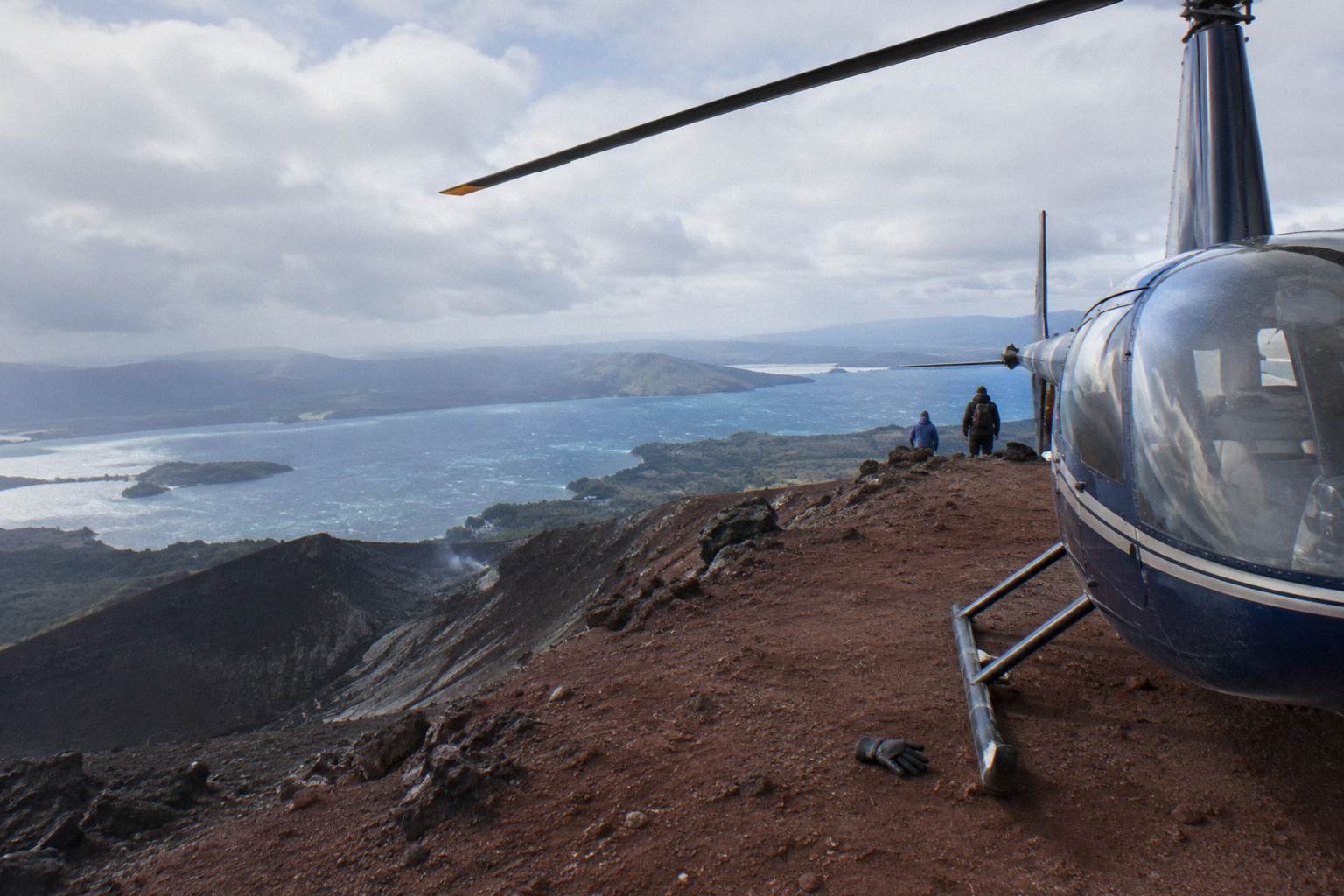
The Volcanic Air 40-Minute Summit Landing Flight costs from NZ$675 per person, is rated 4.9 across 43 reviews and departs the Rotorua City Lakefront helipad on 1 Lakefront Drive. After flying over lakes Okareka, Okataina and Tarawera, the helicopter lands on the summit for a guided walk of 15 to 20 minutes, always at the pilot's sole discretion.
What The Mt Tarawera Helicopter Landing Involves
The Volcanic Air 40-Minute Summit Landing Flight departs the Rotorua City Lakefront helipad at 1 Lakefront Drive, crosses lakes Okareka, Okataina and Tarawera, then lands on the summit of Mt Tarawera for a guided walk of 15 to 20 minutes. It costs from NZ$675 per person, carries a 4.9 rating across 43 reviews, needs 2 adult fares minimum, and the landing is at the pilot's sole discretion.
That single paragraph holds nearly every decision-relevant fact about the trip, and the rest of the article unpacks each piece: the three Volcanic Air landing options side by side, the weight rules per product, the operator's own wording on what happens if the landing cannot go ahead, and how a helicopter day compares with walking up under a guide. Amounts through the article are New Zealand dollars.
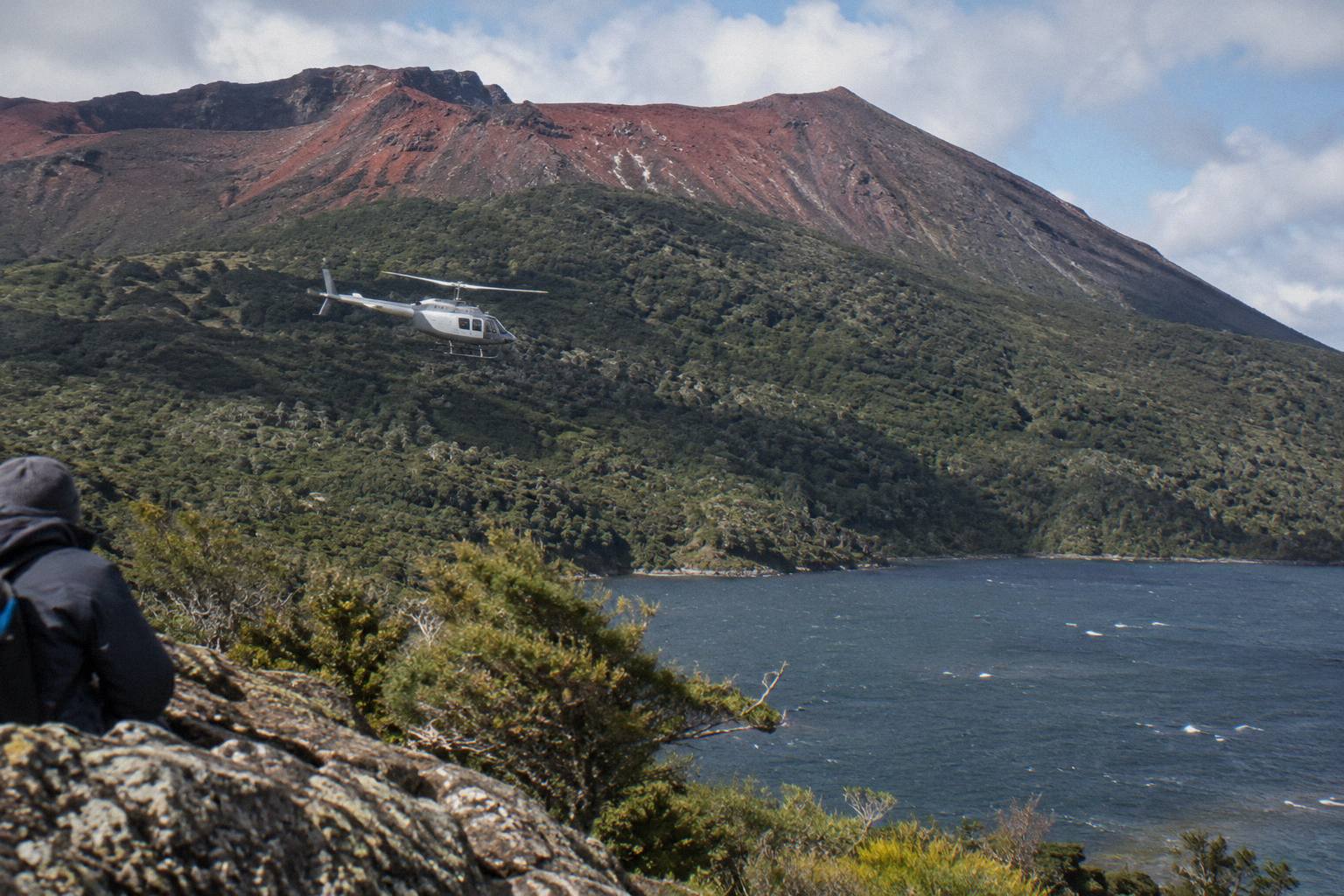
Two operators run the summit trips covered here, and they describe themselves as partners rather than rivals. Kaitiaki Adventures runs the guided walks and the 4WD-and-crater-walk trips, while Volcanic Air runs every helicopter and floatplane option. Kaitiaki's conservation page says the two companies are "proud concessionaires, working alongside Ngati Rangitihi", the iwi that holds kaitiakitanga, or guardianship, of the maunga. The mountain sits on private land governed by Ruawahia 2B Trust, which reinvests most tourism concession revenue in conservation, with wilding pine removal first. That structure is why every summit trip in these pages runs through a licensed operator: read more in who owns Mt Tarawera and why access is guided.
The mountain itself rewards the flight. GNS Science describes Tarawera as one of the dome volcanoes of the Okataina Volcanic Centre and the site of New Zealand's largest eruption during the last 500 years, on the night of 10 June 1886, which destroyed the Pink and White Terraces and killed more than 100 people in nearby villages. Ruawahia Dome, at 1,111 m, is the highest of the three domes, and it is Ruawahia the landing flights touch. The Mt Tarawera Volcano Hike pages cover both ways of reaching it, on foot and by air.
The Three Volcanic Air Landing Options Compared
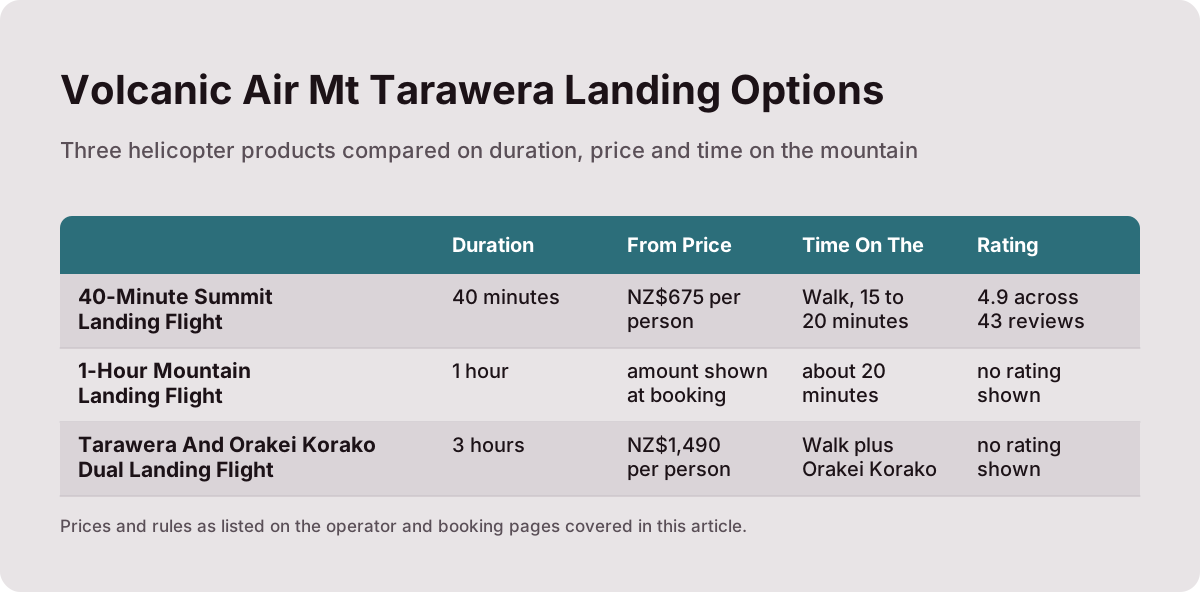
The differences come down to time on the mountain and what else the ticket bundles. The 40-minute flight gives the shortest outing: the lakes crossing, the summit landing and the guided walk, done in under an hour from the lakefront. The 1-hour flight adds headsets to hear the pilot-guide and about 20 minutes on Mt Tarawera as a small-group tour. The dual landing is a half-day outing that pairs the Tarawera landing and guided walk with a ferry transfer to Orakei Korako and a 1-hour self-guided visit there, with admission shown as included.
| Option | Duration | From price | Time on the mountain | Rating |
|---|---|---|---|---|
| Volcanic Air 40-Minute Summit Landing Flight | 40 minutes | NZ$675 per person | Guided walk, 15 min (operator page) or about 20 min (booking page) | 4.9 across 43 reviews |
| Volcanic Air 1-Hour Mountain Landing Flight | 1 hour | the booking page shows the amount for your date | about 20 minutes | no rating shown |
| Tarawera And Orakei Korako Dual Landing Flight | 3 hours | NZ$1,490 per person | landing and guided walk, plus Orakei Korako visit | no rating shown |
For a reader weighing the two pure Tarawera landing flights, the 1-hour product is the closer comparison: same operator, same lakefront departure, same pilot-discretion landing, roughly the same stretch of legs on the summit. Its booking page lists a professional pilot-guide, headsets and about 20 minutes on the mountain, with a total weight limit of 110 kg per passenger. No amount shows for a reason: the fare for a helicopter seat moves with dates and loadings, so the booking page is where the number for your travel day appears.
The dual landing earns its higher figure by doubling the day. Beyond the Tarawera summit walk it includes the ferry across to Orakei Korako, an hour of self-guided wandering through that geothermal valley, and pilot commentary on both legs. Its booking page flags the trip as unsuitable for pregnant travellers, people with mobility impairments and anyone afraid of heights, and it carries a 130 kg per-passenger total weight rule. If the aim is one big volcanic day out of Rotorua rather than the quickest summit touch, that is the format that fits.
One product deliberately left out of the table above: the Tarawera Scenic Floatplane Flyover, from NZ$395 per person and rated 4.8 across 48 reviews, is a flyover with no landing, so it never touches the summit at all. It appears later, where the formats are compared properly.
A few practical points sharpen the choice. The two-adult minimum applies to every product here, so a solo traveller effectively books two seats on any of them. Weight caps differ as well: the 1-hour flight carries the stricter per-passenger limit, the dual landing's stated allowance running 20 kg higher.
Time arithmetic helps too. Of the dual's three hours, only one is the self-guided Orakei Korako visit; the remaining two absorb the summit landing, the ferry crossings and both flight legs. Its entry fare also runs to more than double the 40-minute flight's.
Finally, the suitability warnings appear only on the dual's listing, not on the other two here, so travellers affected face a stated barrier only on the longest option. That silence is not a clearance, so check with the operator before paying if in doubt.
Weight Rules, Ages And Who Can Fly
Each Volcanic Air product carries its own weight rule: 135 kg per seat on the 40-minute flight, where passengers over 110 kg may get specific seating with individual weights taken at booking; 110 kg total per passenger on the 1-hour flight; and 130 kg total on the dual landing. Infants sit on laps on every flight, all three need at least 2 adult fares, and none is wheelchair accessible. Age rules are not published, so ask Volcanic Air.
Helicopter weight limits are about physics, not policy. Seats, fuel and the aircraft's total payload fix how much each passenger can bring aboard, which is why the numbers differ between products and why individual weights get taken at booking on some of them. Weighing in at the lakefront is routine and quick, and it is the reason the operators ask for weights up front rather than at the aircraft door.
| Product | Weight rule | Infants | Minimum fares | Wheelchair accessible |
|---|---|---|---|---|
| 40-Minute Summit Landing Flight | 135 kg per seat; over 110 kg may mean specific seating, individual weights at booking | sit on laps | 2 adult fares | no |
| 1-Hour Mountain Landing Flight | 110 kg total per passenger | sit on laps | 2 adult fares | no |
| Dual Landing Flight | 130 kg total per passenger | sit on laps | 2 adult fares | no |
| Scenic Floatplane Flyover | 135 kg per seat | sit on laps | see booking page for minimum numbers | no |
The 2-adult-fare minimum matters for solo travellers: a single booking can be matched with other passengers, but the flight needs two paid adult fares before it operates. Families should note the lap-infant rule and raise ages directly with Volcanic Air, since no age minimum appears on the booking pages read. For anyone weighing a walk instead, ages are published there: the Kaitiaki half-day crater walk takes children from 7 years, its Kaituna rafting combo from 13, and both ask for moderate fitness. Age limits by product are covered in full in guided hiking on Mt Tarawera with kids.
What Happens If The Landing Cannot Go Ahead
Volcanic Air's own wording is that tour duration, flight times and inclusions may vary due to weather conditions, volcanic activity and passenger loadings, and that excursion landings are undertaken at your own risk and at your pilot's sole discretion. The booking pages for the 40-minute flight offer free cancellation up to 24 hours, and a full refund is given if the operator cancels for weather. A landing is never guaranteed, and neither is a view.
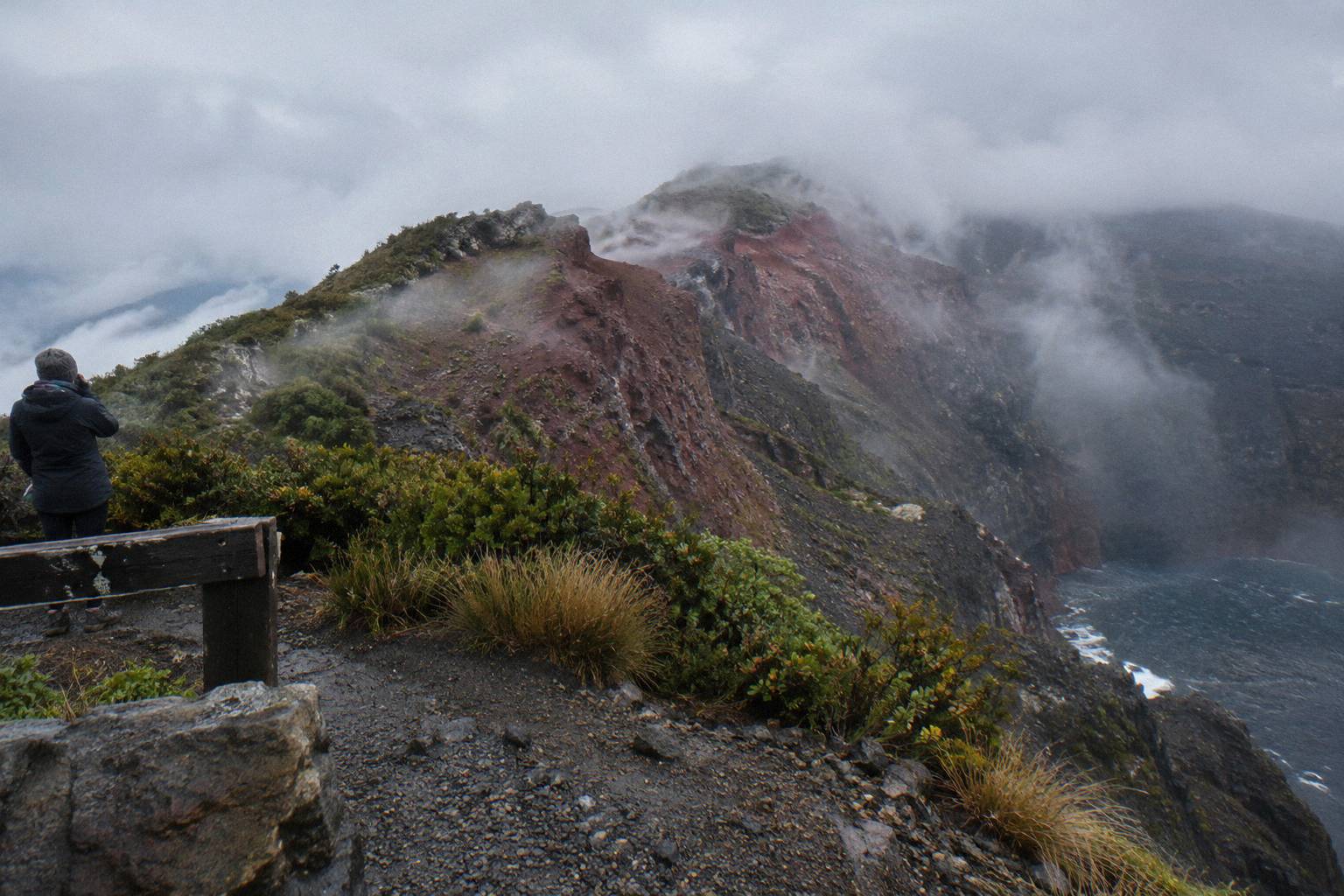
Reading that wording closely does two useful things before money changes hands. First, it sets the expectation that the pilot, not the customer and not the sales copy, makes the landing call on the day, weighing wind, cloud, volcanic activity and how the aircraft is loaded. Second, it quietly aligns with the volcano's own status: GeoNet publishes the current volcanic alert level for Okataina, the caldera that contains Tarawera, and that level can change on any given day, so a live check before a flight day is never wasted (GeoNet's volcano page shows the live reading).
| Situation | Operator wording | What the booking page adds |
|---|---|---|
| Weather, volcanic activity or loadings change | "Tour duration, flight times and inclusions may vary" | the flight still departs with adjustments where safe |
| The pilot declines the landing | landings "are at your pilot's sole discretion" and "undertaken at your own risk" | the trip runs as a flight over the route instead |
| You cancel | free cancellation | up to 24 hours before, on the booking page |
| The operator cancels for weather | full refund | stated on the 40-minute flight and floatplane booking pages |
The refund picture is strongest on the customer side as well as the operator side. Every one of the six tours covered across these pages carries free cancellation up to 24 hours on its booking page, and the 40-minute landing flight and the floatplane both say a full refund follows if the operator itself cancels for weather. Kaitiaki's own weather and cancellation policy is not published on its pages, so ask when booking a walk. Planning around the sky is worth a paragraph of its own: how weather affects the crater walk and landings unpacks the seasonal side.
The Flight Route And The Guided Walk On The Summit
The 40-minute flight departs Lakefront Drive on the Rotorua City Lakefront and passes over lakes Okareka, Okataina and Tarawera before the summit landing, per the operator's page. Once down, the guided walk runs 15 minutes by that same operator page and about 20 minutes by the booking page, a short stretch of legs on the crater rim with pilot-guide commentary before the return flight to the lakefront.
The three-lake crossing is the scenic spine of the outbound leg. Rotorua's lakefront helipad sits at 1 Lakefront Drive in Ohinemutu, and the route east strings together Okareka, Okataina and Tarawera in quick succession, each lake a filled volcanic basin from the wider Okataina Volcanic Centre that GNS Science documents. No helicopter model, speed or altitude figures appear on the operator's pages, and none are invented here: the flight is described exactly as Volcanic Air describes it.
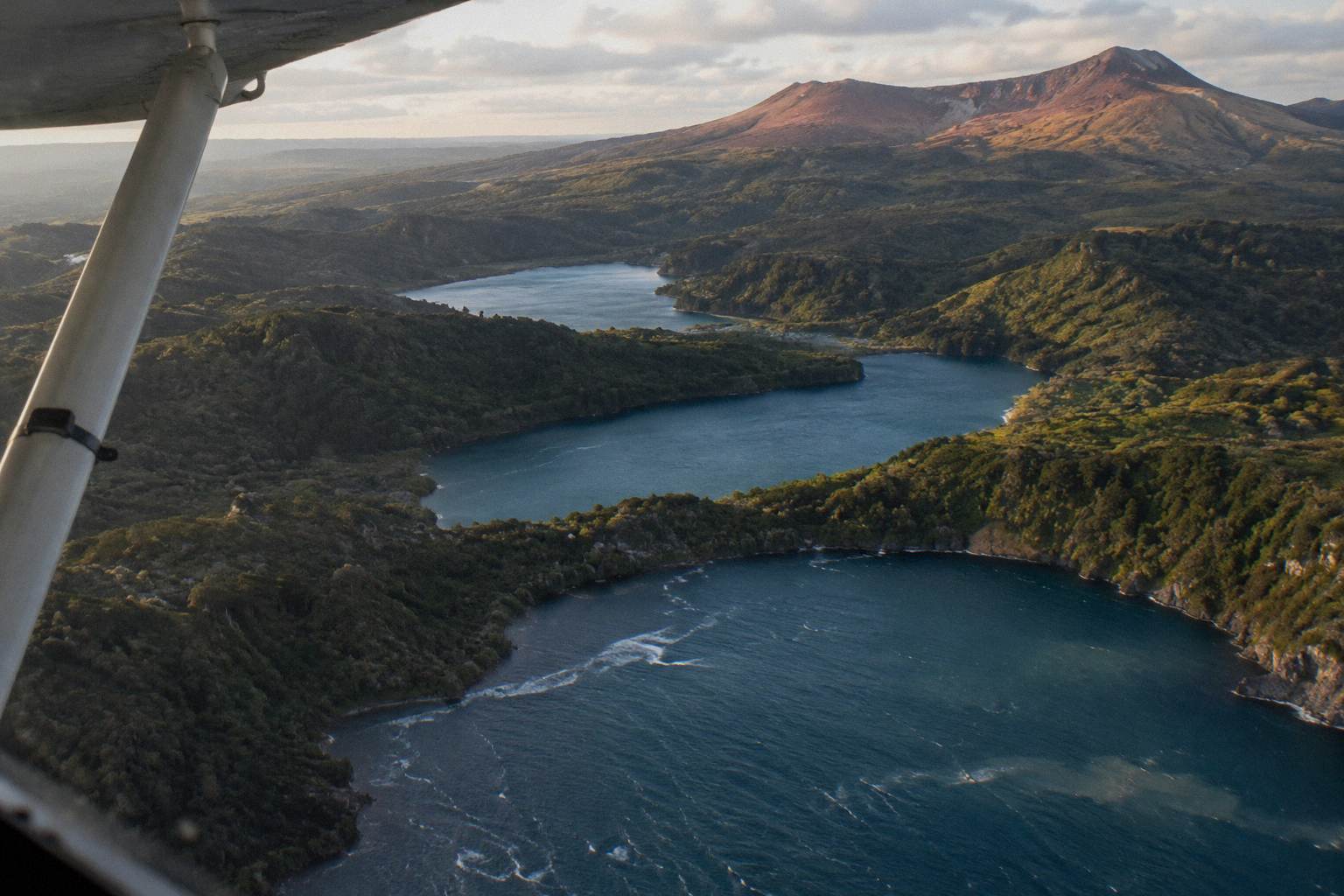
The walk itself is deliberately short, which is the point of the format. Where the Kaitiaki half-day trip spends about 90 minutes on a guided crater walk after a 4WD ascent, the helicopter format trades trail time for air time and still puts boots on the summit. Fifteen to twenty minutes is enough to stand on Ruawahia's rim, take in the rifted ground below and hear the pilot-guide's commentary, without the fitness demand of the walking option. Readers deciding between those two shapes of day will find the full comparison in walking, 4WD or helicopter for Mt Tarawera.
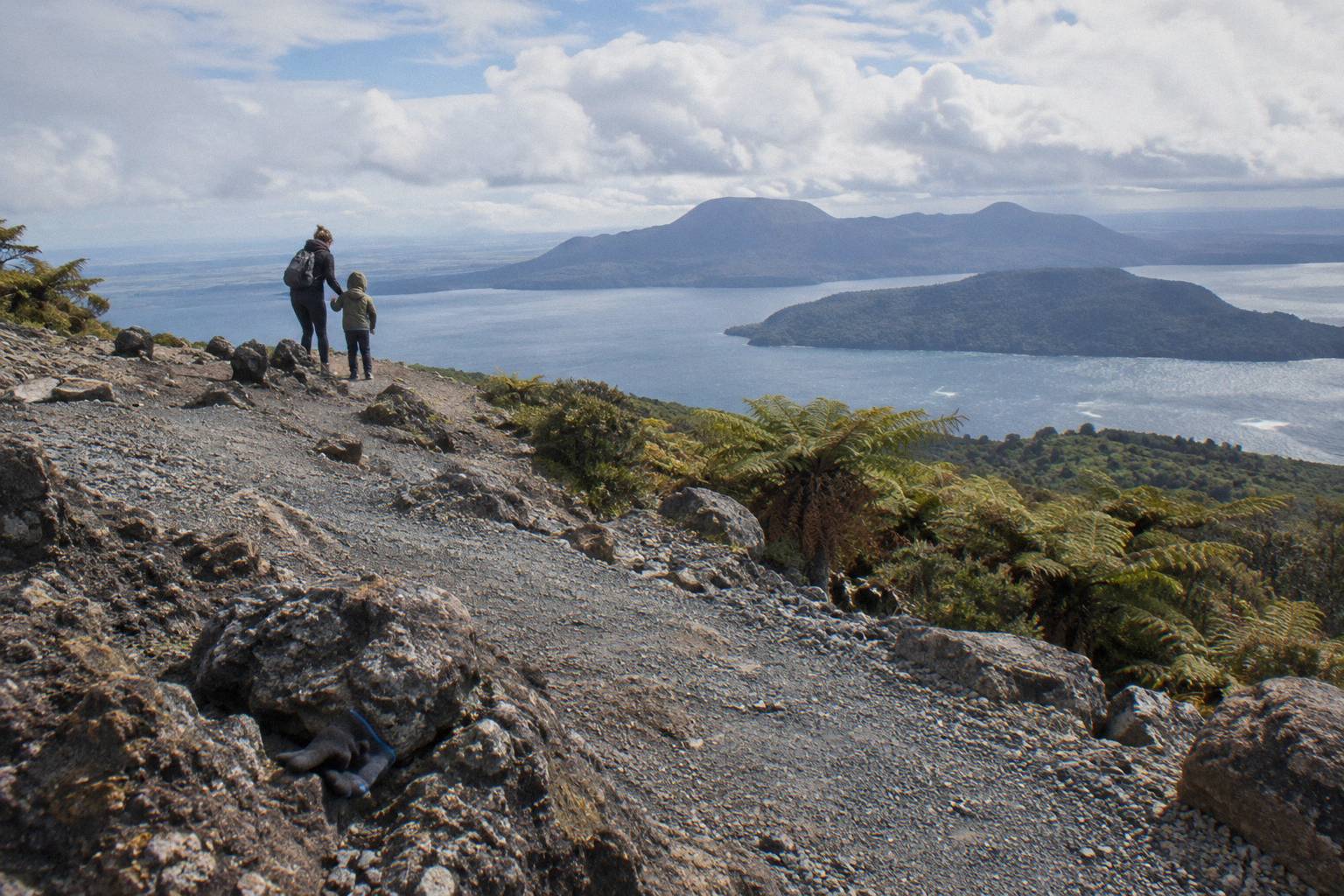
One framing worth carrying onto the summit: the ground under those boots was torn open on the night of 10 June 1886, in what GNS Science calls New Zealand's largest eruption of the last 500 years. The sound was heard as far as Blenheim and ash fell as far as Christchurch. Standing on that rim with twenty minutes and a guide's commentary is a compressed history lesson that the flyover, for all its views from above, cannot quite deliver.
Helicopter Landing, Flyover Or Walking Up With A Guide
Three formats reach or view the mountain: a helicopter landing with a summit walk (from NZ$675 per person, 40 minutes), a floatplane flyover with no landing (from NZ$395 per person, 4.8 across 48 reviews, 30 minutes), and a guided 4WD-and-walk day on the summit track (4.9 across 359 reviews, 4 hours 30 minutes, amount on the booking page). Each suits a different budget, timeframe and fitness level.
The format decision is really three smaller decisions. Time: forty minutes suits a morning gap in a Rotorua itinerary, while the walk consumes half a day. Money: the flyover starts at NZ$395 per person, the landing flight at NZ$675, and the walk's amount shows on its booking page for the date. Body: the walk needs moderate fitness, a roughly 45-degree scree slope described as about 400 m deep by Kaitiaki's FAQ, and steady shoes, while the flights need no fitness beyond the aircraft steps.
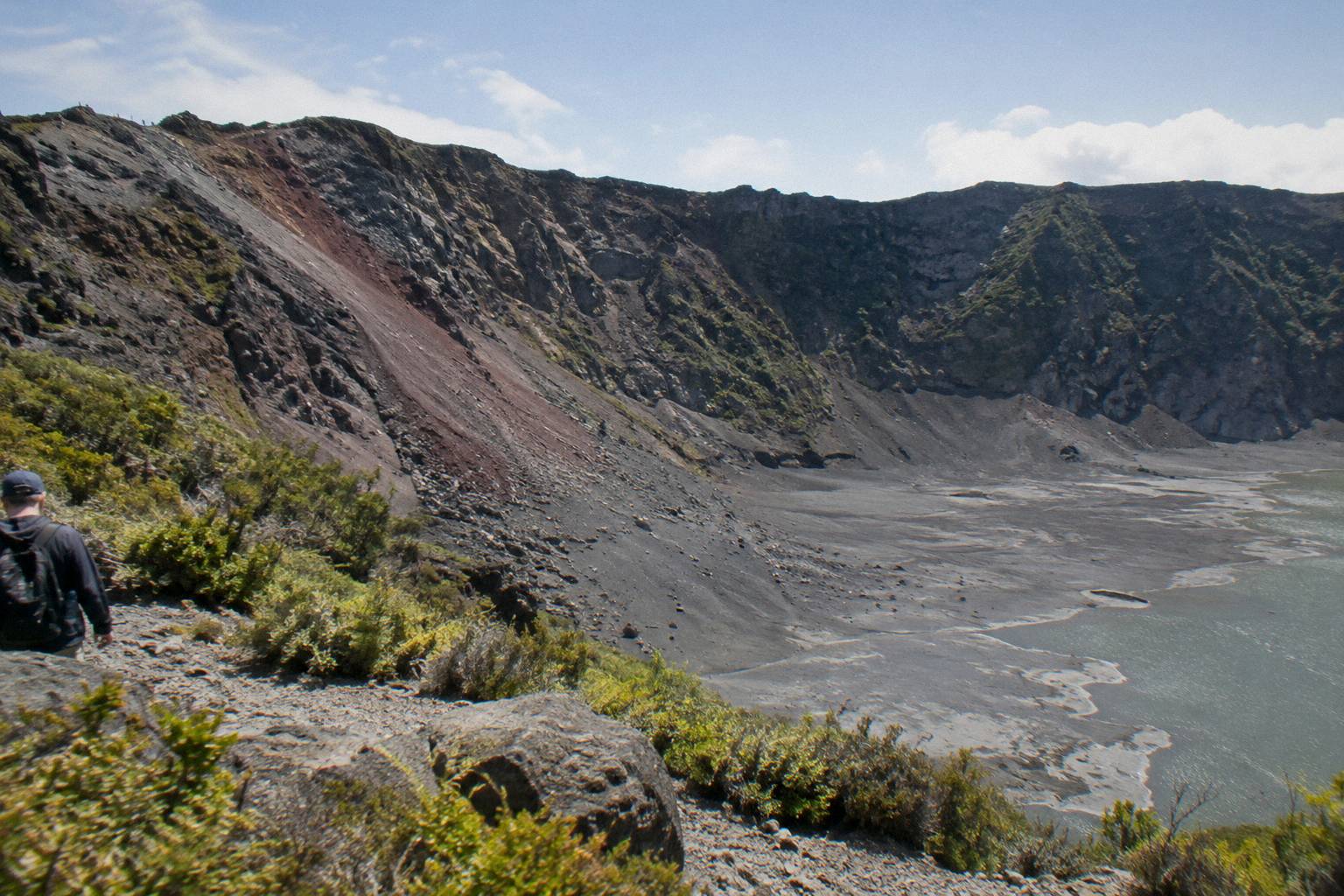
The Kaitiaki Half-Day 4WD And Crater Walk is the walking counterpart to everything above. It meets at the Main Carpark on Hemo Road in Whakarewarewa, offers free pickup from central Rotorua accommodation on the booking pages, drives about 30 minutes to the mountain and then roughly 8.2 km up a 4WD track to where the hikoi, the walk, begins. About 90 minutes of guided crater walking follows, including the optional scree run into the crater itself, and the whole outing runs 4 hours 30 minutes. Kaitiaki provides no snacks, so water and food come along in the pack.
The flyover, by contrast, never touches the ground. The Tarawera Scenic Floatplane Flyover, 4.8 across 48 reviews, is a 30-minute flight over Mt Tarawera and the surrounding volcanic landscape with pilot commentary, departing the floatplane base on the same Lakefront Drive. It is the gentlest entry to seeing the mountain from the air, at the lowest starting figure of the three, and it suits travellers who want the aerial picture without the landing question. It does not land, and every mention of it here says so.
Cost, Cancellation And Booking Smart
The from-prices are NZ$675 per person for the 40-minute landing flight, NZ$1,490 per person for the dual landing and NZ$395 per person for the floatplane flyover, while the 1-hour flight and the Kaitiaki products show their amounts on the booking page for each date. All six tours carry free cancellation up to 24 hours, and the two Volcanic Air booking pages noted above add a full refund when the operator cancels for weather.
Those from-prices are per-person starting figures in New Zealand dollars, and helicopter fares in particular move with dates and loadings, which is why the 1-hour flight prints no amount at all: the number for a given day appears during booking. No child, family, combo or promotional price is published on any page read, so treat the from-figures as the floor for planning and check the live amount before deciding anything final.
Booking smart on a helicopter product comes down to timing and flexibility. Lock the flight early in a Rotorua stay rather than on the last morning, so a weather-cancelled landing leaves room to rebook. Keep the 24-hour cancellation window in mind as plans firm up. And weigh the departure point: every Volcanic Air product meets at the Lakefront Drive helipad or floatplane base and ends back there, with no hotel pickup claimed, while the Kaitiaki walk meets at Hemo Road with central-accommodation pickup offered on its booking pages. The full costs-and-inclusions picture for the walking side sits in what the Mt Tarawera crater walk costs.
The 40-minute flight remains the sharpest version of the helicopter idea: the Volcanic Air summit landing tour page holds the current details, and check availability shows the live amount for any date.
Mistakes To Avoid Before Booking A Landing Flight
Five mistakes repeat across helicopter bookings: assuming the landing is guaranteed when it sits at the pilot's sole discretion, skipping the weight rules and being surprised at check-in, booking the flyover while expecting a summit landing, ignoring the 2-adult-fare minimum as a solo traveller, and scheduling the flight on the final morning of a trip with no room to rebook after weather moves. Each one is avoidable with a few minutes of planning.
The landing assumption is the big one. Volcanic Air's wording could not be plainer, and a flight that becomes an overflight because the pilot reads the wind differently is a risk that comes with the format, softened by the operator's own full-refund practice when it cancels for weather. Weight comes second: the per-product rules above differ for a reason, and declaring accurate weights at booking avoids seating surprises on the day.
Third, read product names carefully. The floatplane product is a flyover with no landing, and every sentence describing it here repeats that fact because confusing it with a landing flight is the easiest booking error in the set. Fourth, solo travellers should ask about the 2-adult-fare minimum when booking, since matching with other passengers usually solves it but confirms better in advance. Fifth, give the flight room: a mid-trip booking that weather postpones can be rebooked, while a departure-day flight that cancels simply ends the option.
A sixth, quieter mistake is treating the flight as the only way to value the mountain. The guided walk tells the volcanic story at walking pace, with the 1886 rift underfoot and a guide narrating it, and the two formats genuinely suit different travellers. Choosing between them carefully, with time in hand and a fallback in mind, beats choosing quickly under pressure at the end of a trip.
Common Questions About The Mt Tarawera Helicopter Landing
Does The Helicopter Actually Land On Mt Tarawera?
Yes, when the pilot approves it. The 40-minute flight lands on the summit for a guided walk of 15 minutes by the operator page or about 20 minutes by the booking page, but Volcanic Air states that excursion landings are undertaken at your own risk and at your pilot's sole discretion, depending on weather, volcanic activity and passenger loadings.
How Much Does The Mt Tarawera Helicopter Landing Cost?
The Volcanic Air 40-Minute Summit Landing Flight costs from NZ$675 per person. The 1-Hour Mountain Landing Flight shows its amount on the booking page for your date, and the Tarawera And Orakei Korako Dual Landing Flight starts from NZ$1,490 per person.
Where Does The Flight Depart From?
All Volcanic Air flights meet at the Rotorua City Lakefront, 1 Lakefront Drive in Ohinemutu: the helicopter tours at the lakefront helipad and the floatplane at its adjacent base. Trips end back at the same point, and no hotel pickup is claimed.
What Are The Weight Limits?
The 40-minute flight allows 135 kg per seat, with passengers over 110 kg possibly given specific seating and individual weights taken at booking. The 1-hour flight carries a 110 kg total per-passenger rule and the dual landing 130 kg total per passenger.
What Happens If Weather Cancels The Landing?
The flight may still run with varied duration and inclusions, since the operator's wording says tour elements may vary with conditions. The booking page offers free cancellation up to 24 hours, and a full refund is given if the operator cancels for weather.
Is The Helicopter Better Than Walking Up With A Guide?
Neither is better; they are different formats. The helicopter compresses the day to 40 minutes and about 20 on the summit, while the Kaitiaki half-day walk takes 4 hours 30 minutes, needs moderate fitness and spends about 90 minutes on a guided crater walk after a 4WD ascent. Budget, timeframe and fitness decide it.