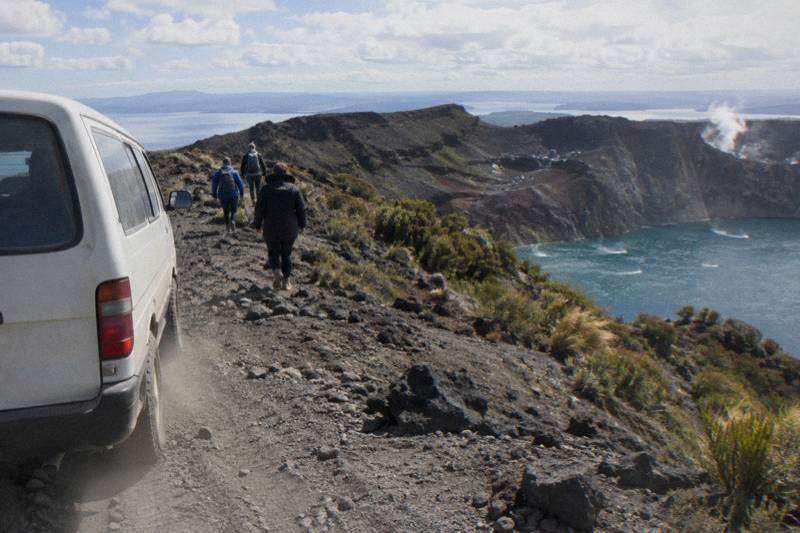
Waimangu Volcanic Valley And The Mt Tarawera Crater Walk
Waimangu Volcanic Valley grew out of the rift that tore Mt Tarawera open on the night of 10 June 1886, which makes the two places two halves of one story: the mountain you can climb, and the valley the eruption left behind.
Short answer
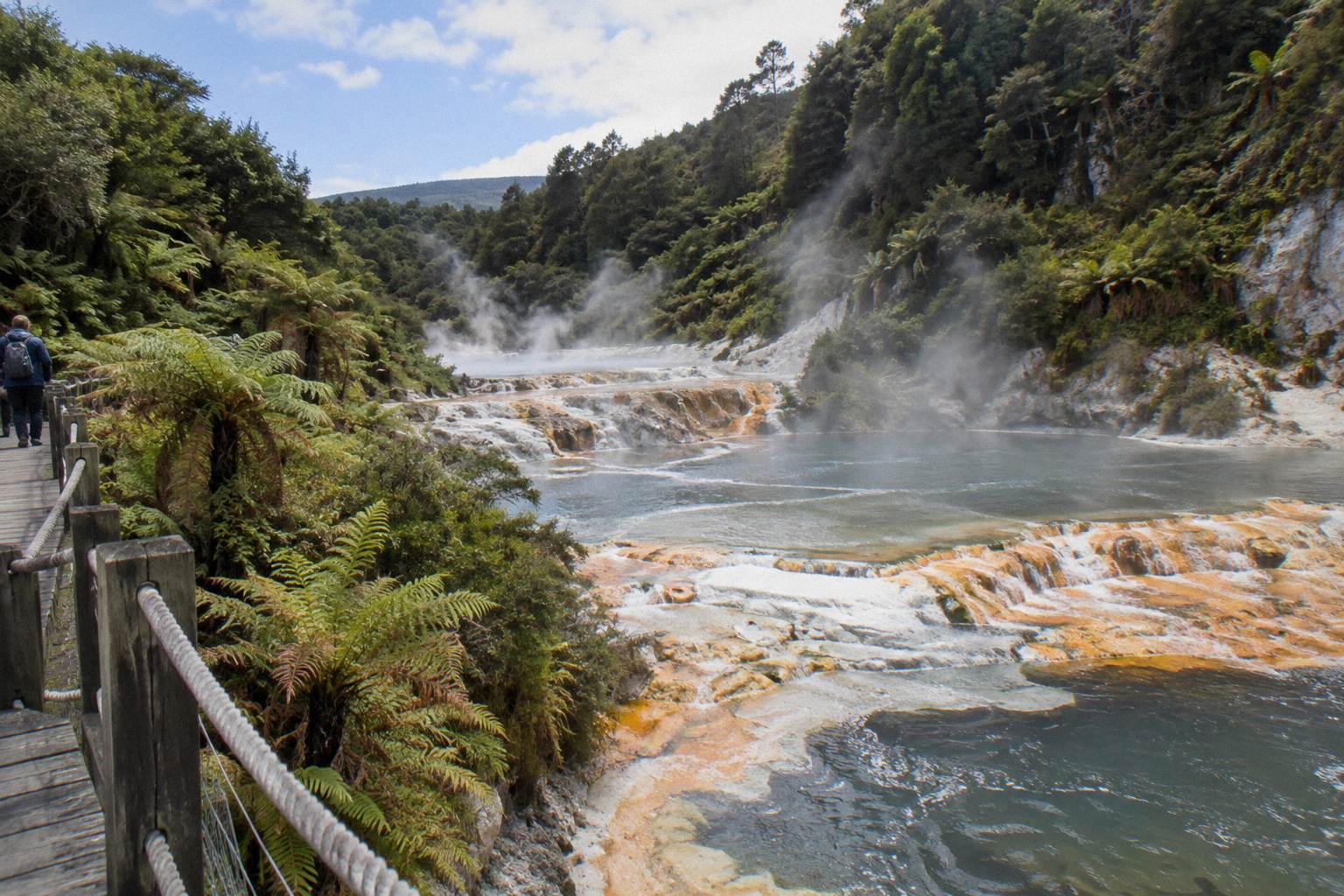
Waimangu Volcanic Valley sits at 587 Waimangu Road near Rotorua and describes its geothermal system as formed by the eruption of 10 June 1886. Pair it with a guided crater walk (from 4 hours 30 minutes), a 40-minute helicopter landing flight (from NZ$675 per person), or a 30-minute flyover (from NZ$395 per person, flyover, no landing).
Waimangu Volcanic Valley and Mt Tarawera are two chapters of the same event. On the night of 10 June 1886 the mountain split open, and the geothermal system at Waimangu, at 587 Waimangu Road south of Rotorua, describes itself as formed as a result of that eruption. Climb the mountain and you look down on the landscape the eruption reshaped. Walk Waimangu and you walk through what the eruption left boiling. Do both and the day stops being two attractions and becomes one story told from two ends. All tour amounts below are New Zealand dollars.
Where Is Waimangu Volcanic Valley And Why Pair It With The Volcano?
Waimangu Volcanic Valley is a separate attraction at 587 Waimangu Road, reached from Rotorua, and it grew directly out of the 1886 eruption of Mt Tarawera. Pairing it with a guided crater walk or a summit flight works because both experiences explain the other: the mountain gives you the view of the rift, and the valley shows you the geothermal aftermath still running more than a century later.
The valley is not part of the mountain trip and no tour here combines the two on one ticket. That separation is exactly why the pairing works so well. A guided Mt Tarawera experience is a half day at most for walkers, with the Kaitiaki Half-Day 4WD And Crater Walk running 4 hours 30 minutes, and a helicopter landing flight is shorter still at 40 minutes for the Volcanic Air 40-Minute Summit Landing Flight. Either one leaves most of a day free, and a valley visit slots into the remainder without rushing.
The other reason to pair them is narrative. Standing on Ruawahia Dome, the highest of the mountain's three domes at 1,111 metres, you see the sweep of lakes and bush country to the south. At Waimangu you stand inside the consequence. Guides on the mountain talk about the eruption; the valley is the eruption's continuing afterlife. Visitors who do only one half tend to miss what gives the region its scale.
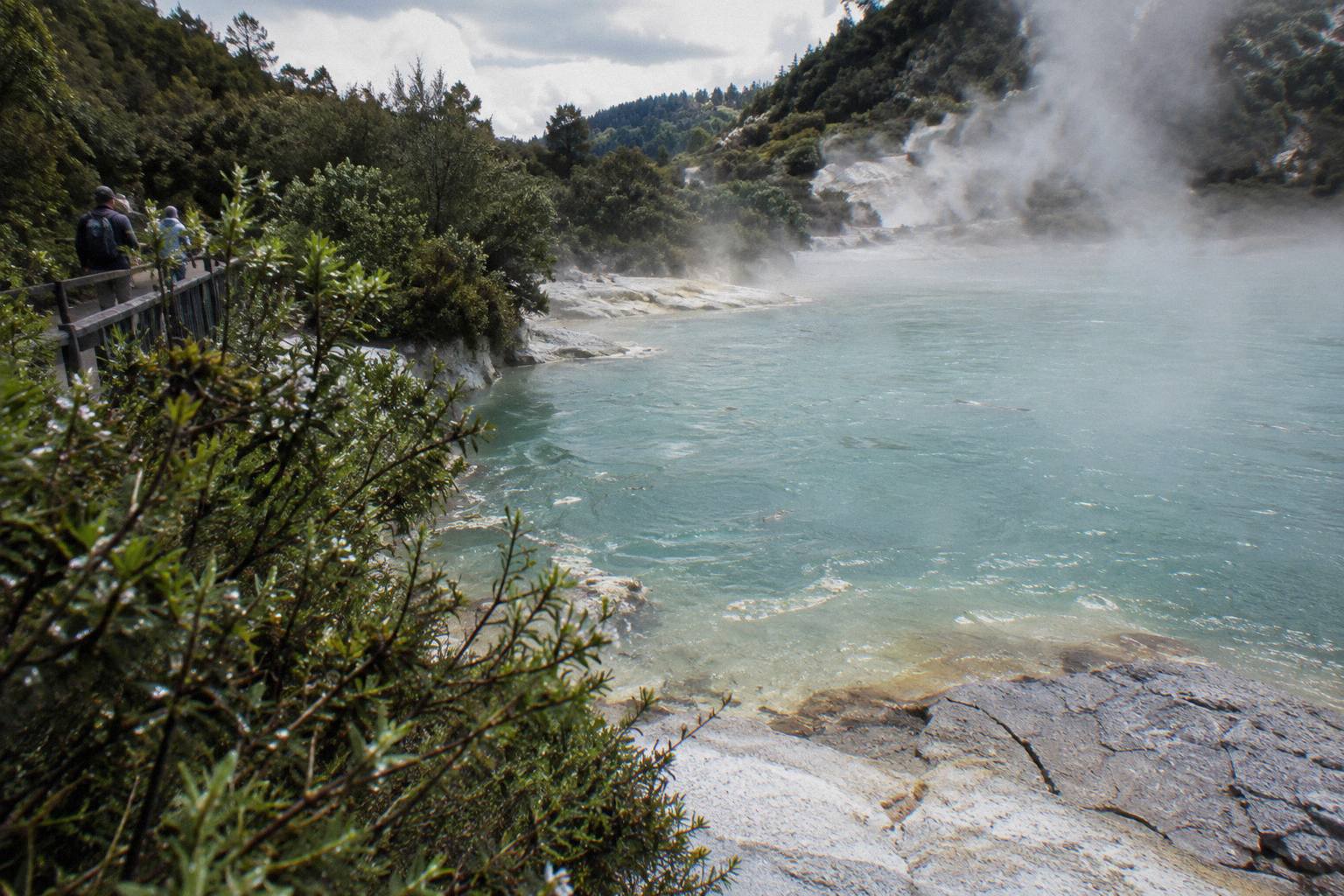
For the practical picture, the table below holds what the operator and official pages give. Treat a visit as its own half-day planning block and check Waimangu's own pages for current entry details.
| Fact | Detail |
|---|---|
| Address | 587 Waimangu Road |
| Origin | Geothermal system formed as a result of the volcanic eruption of 10 June 1886, per the operator |
| Relationship to the mountain | Separate attraction; no combined ticket with any Tarawera tour |
| Walk length and features | Check Waimangu's own pages or ask when you book |
| Best pairing | The morning or afternoon a guided crater walk or landing flight leaves free |
If you want the fuller background on the eruption itself, the Mount Tarawera eruption of 1886 and the crater walk goes deeper into the night and what it did to the landscape you will see from both places.
How The Night Of 10 June 1886 Connects The Two Places
The eruption of 10 June 1886 is the link: GNS Science calls it New Zealand's largest eruption during the last 500 years, and it killed more than 100 people in villages near the mountain. Tarawera is one of the dome volcanoes of the Okataina Volcanic Centre, and Waimangu's geothermal system formed as a result of it, so the valley is treated as the eruption's living output rather than a separate curiosity.
The bare facts are startling even before you stand anywhere. The sound of the eruption was heard as far as Blenheim, and ash fell as far as Christchurch, both per the GNS Science fact sheet. Those two distances bracket the North Island and the South Island. A single night did that. When a guide on the mountain points south toward the lakes and mentions 1886, that reach is the context.
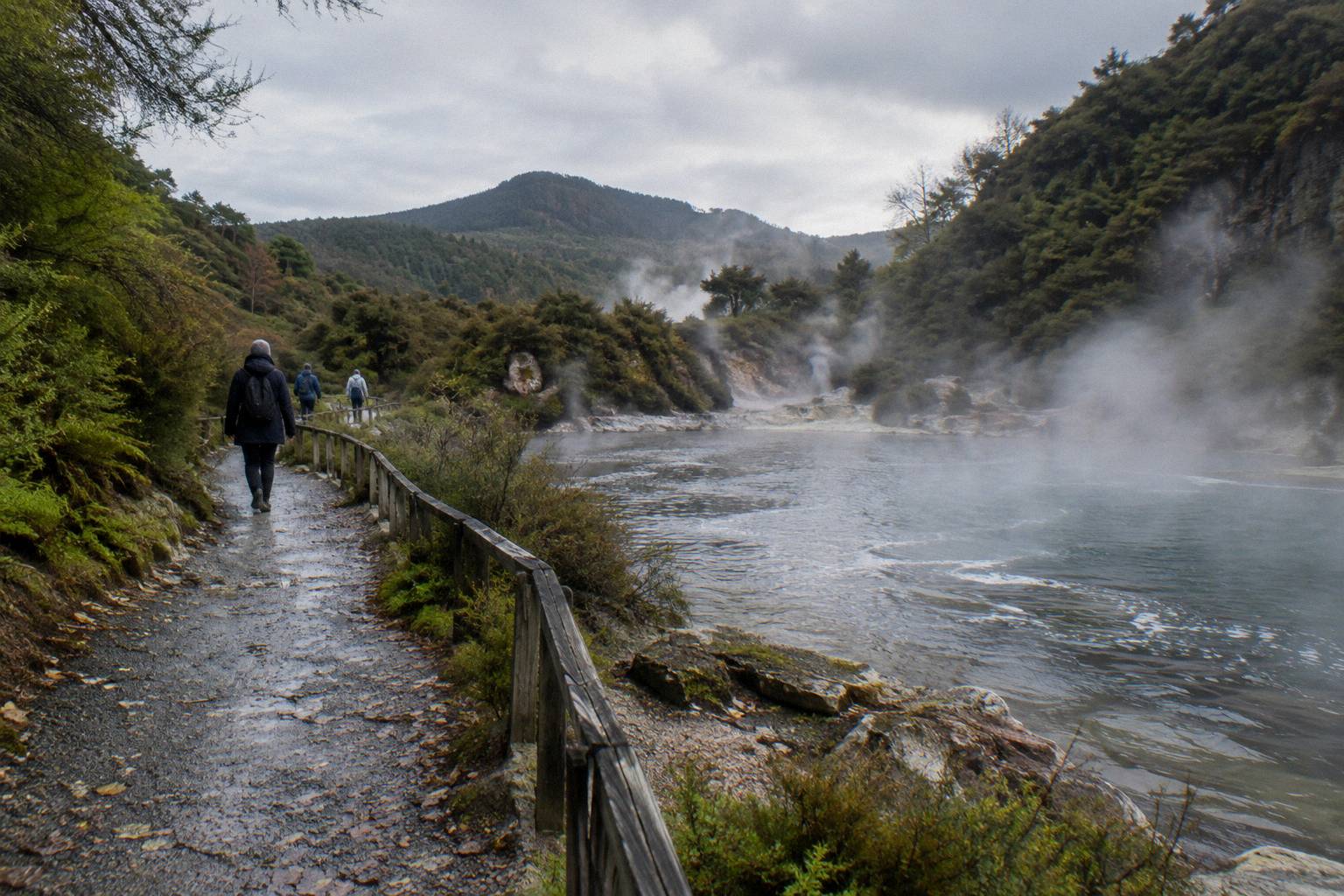
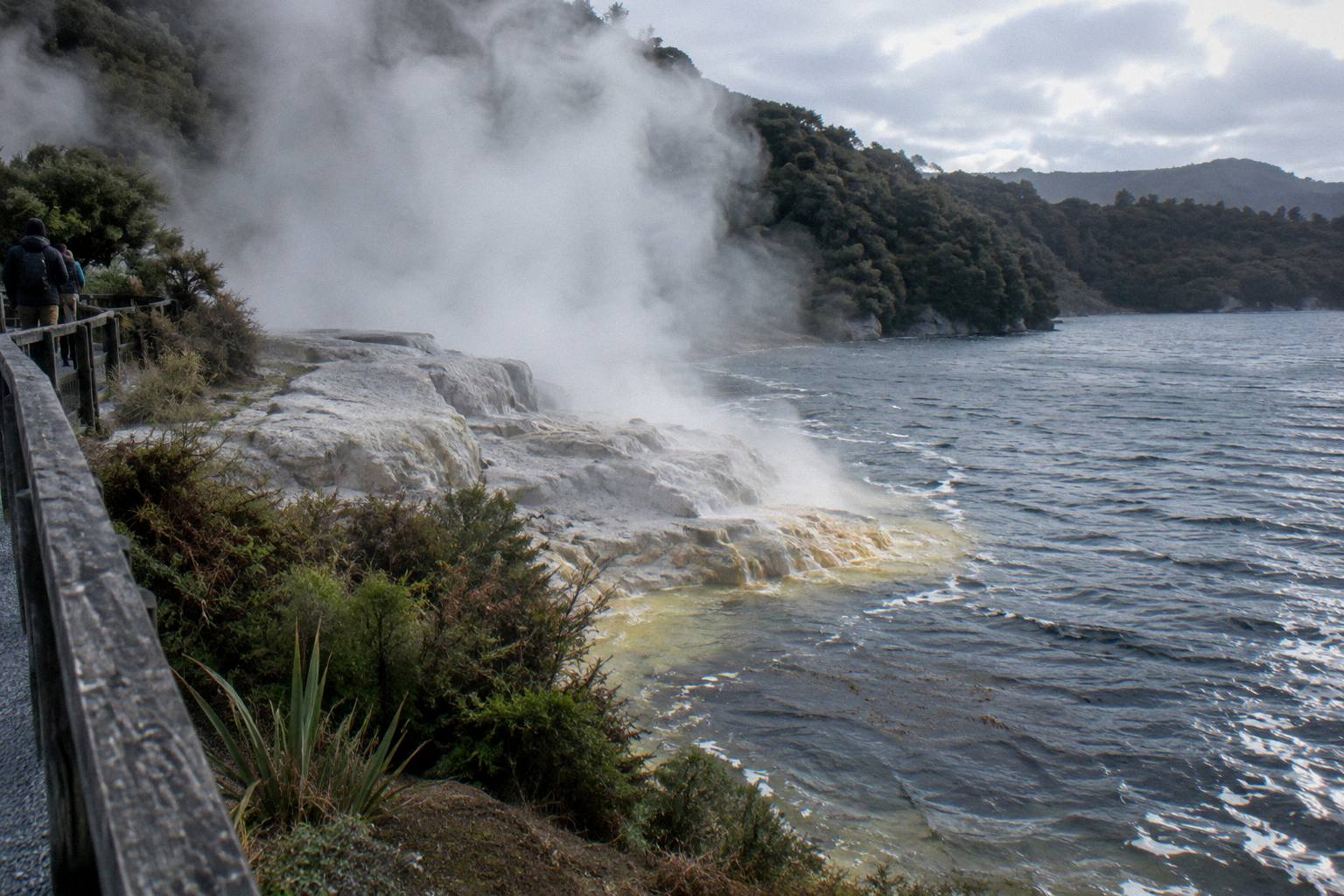
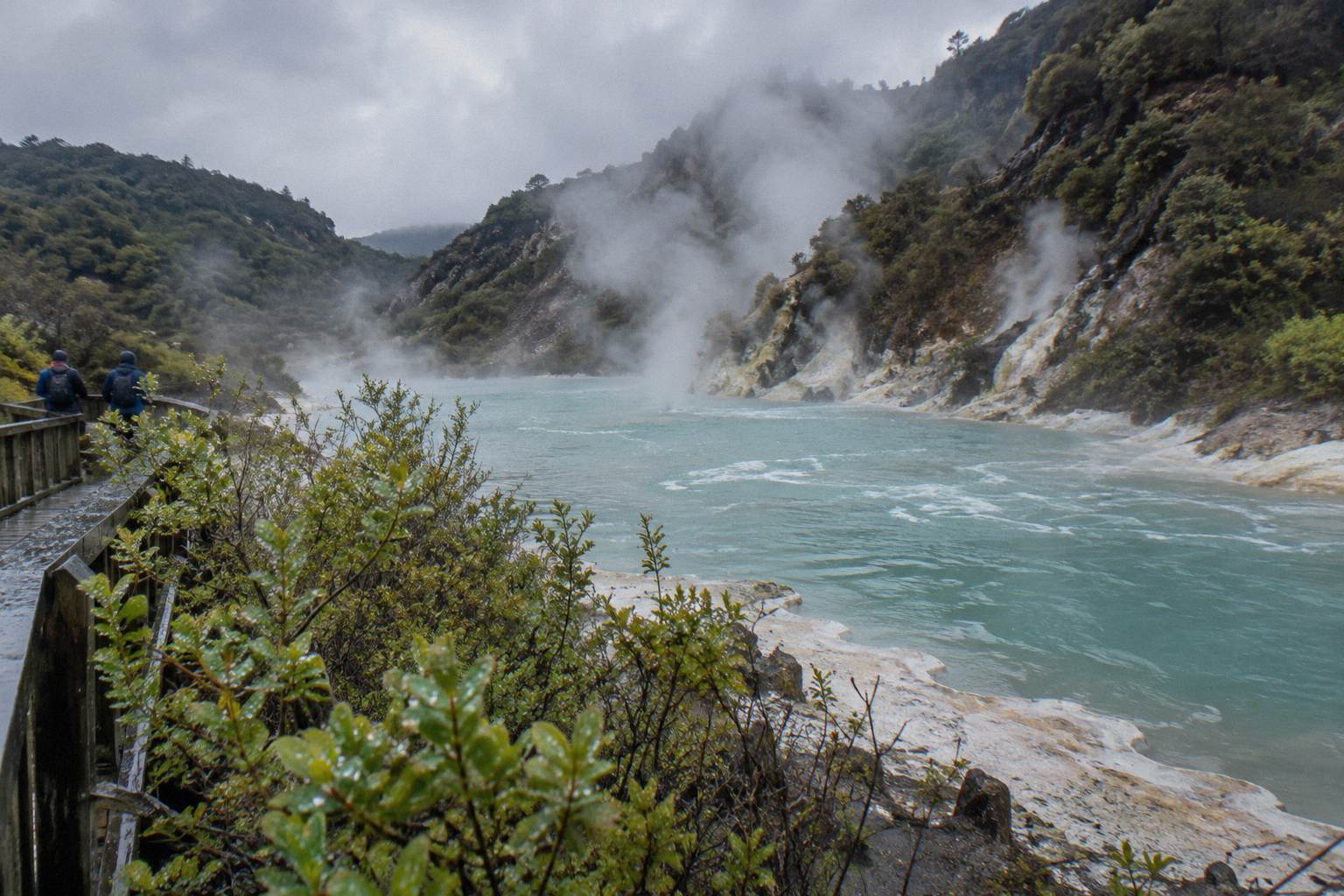
Waimangu's own framing is the part most first-time visitors have not heard. The operator describes the valley's geothermal system as having formed as the result of that eruption, which means the pools and steam you see there are, in the operator's words, younger than the eruption. Very few geothermal attractions on Earth can claim a founding date at all. That is the valley's information gain: it is not ancient geology, it is a documented aftermath.
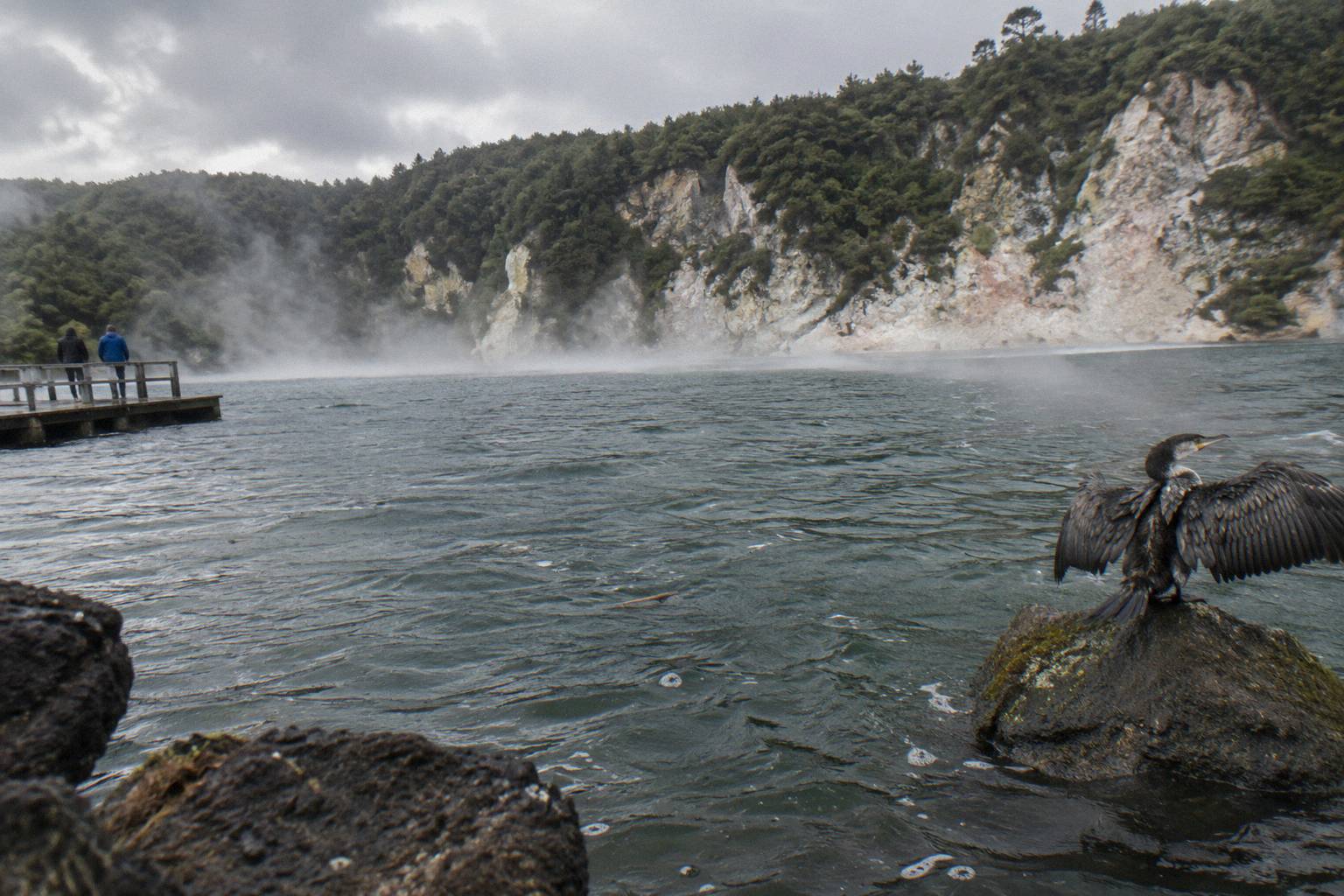
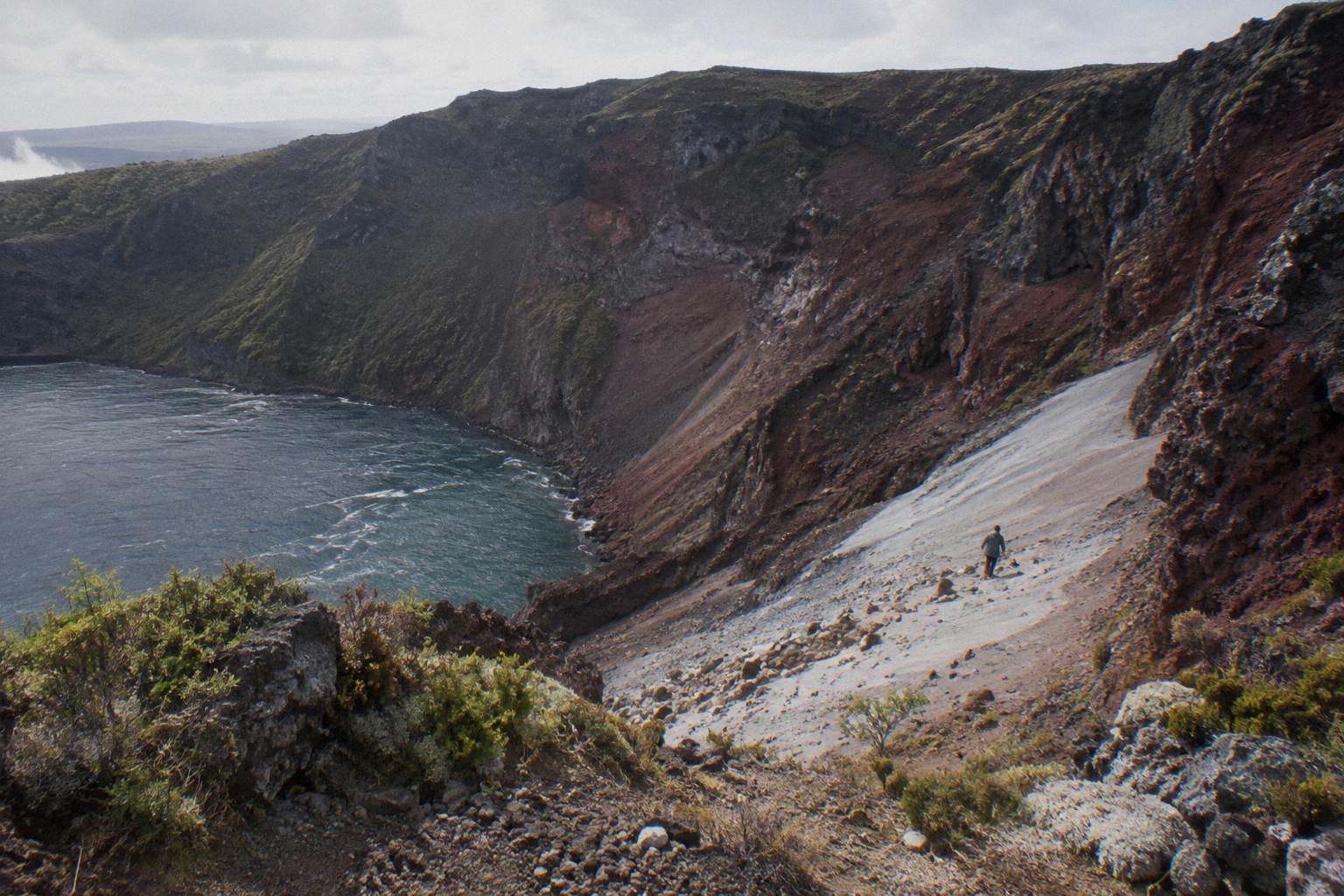
On the mountain itself the story is told from above. The crater walk crosses volcanic scoria where the ground is the eruption's debris, and Kaitiaki's own FAQ describes the scree run as a 45-degree slope approximately 400 metres deep, in the operator's wording. The Pink and White Terraces, destroyed in the eruption per GNS, also belong to this story; a small portion of the Pink Terraces was reportedly rediscovered under Lake Rotomahana in 2011, so the loss was not quite total. The Pink and White Terraces and the Mt Tarawera crater walk covers that thread on its own.
One caution on wording: the mountain is often called an active volcano in passing. GeoNet publishes the current volcanic alert level for the Okataina Volcanic Centre, the caldera that includes Tarawera, so check it before you travel. GNS describes Tarawera as a dome volcano inside an active caldera, which is a more precise sentence than a flat "active volcano" label. For the current level, GeoNet's volcano page is the live source.
Which Tours Show The 1886 Landscape Best?
Four tours answer it best: the guided 4WD crater walk (4 hours 30 minutes, rated 4.9 from 359 reviews), a 40-minute helicopter landing flight (from NZ$675 per person, 4.9 from 43 reviews), the dual landing pairing the mountain with Orakei Korako (3 hours, from NZ$1,490 per person), and the floatplane flyover (from NZ$395 per person, 4.8 from 48 reviews, no landing). Each reveals a different face of the 1886 landscape.
None of these tours visits Waimangu itself. The dual landing's second stop is Orakei Korako, a different geothermal attraction, reached by ferry, with a 1-hour self-guided visit and admission shown as included on the booking page. But every one of the four flies over or walks on ground the eruption made, and the flyover route in particular passes above the volcanic landscape between the mountain and the valley, per the operator's floatplane page, which describes flights over Mt Tarawera and Waimangu.
The choice between them is a choice of format, not of quality. Walkers get the scoria under their boots and the optional scree run. Landing-flight passengers get lakes Okareka, Okataina and Tarawera below them on the way in, then a guided walk on the summit, with landing at the pilot's sole discretion depending on weather, volcanic activity and passenger loadings, in Volcanic Air's wording. Flyover passengers stay airborne with pilot commentary and no landing at all. The dual landing adds the most ground in one booking: mountain walk plus a second geothermal stop, about 3 hours end to end.
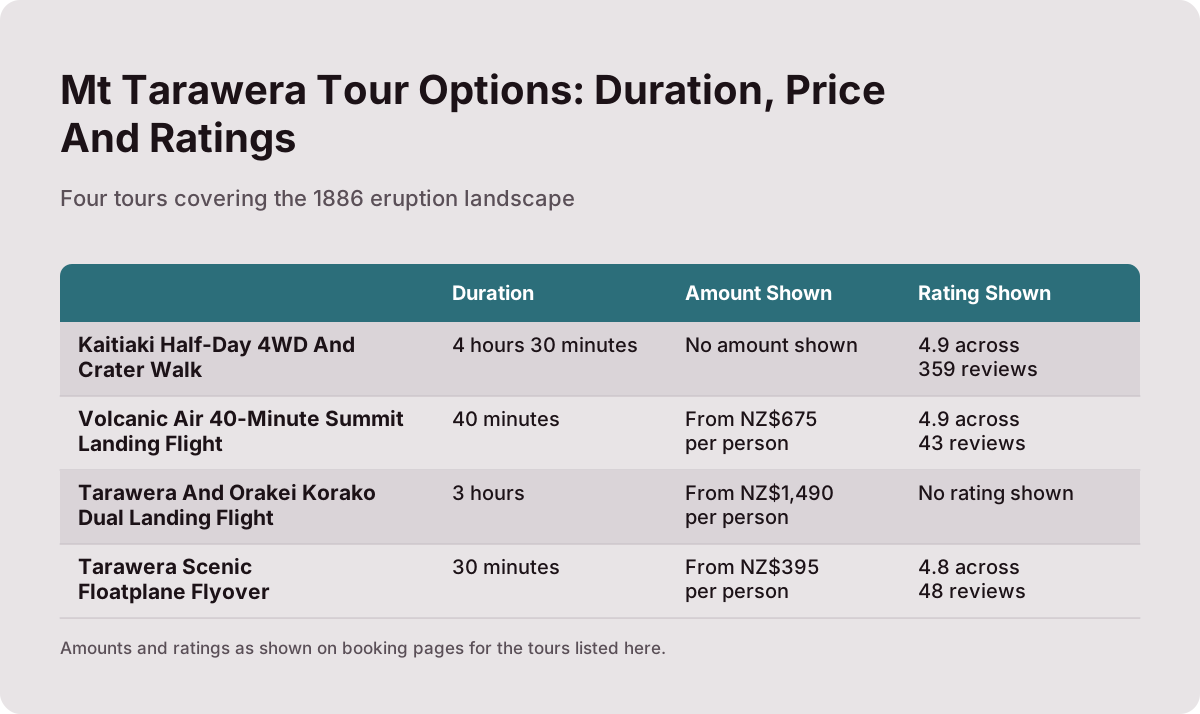
| Option | Format | Duration | Amount shown | Rating shown |
|---|---|---|---|---|
| Kaitiaki Half-Day 4WD And Crater Walk | 4WD ride and guided crater walk on foot | 4 hours 30 minutes | No amount shown; the booking page shows the amount for your date | 4.9 across 359 reviews |
| Volcanic Air 40-Minute Summit Landing Flight | Helicopter flight with summit walk, landing at the pilot's discretion | 40 minutes | From NZ$675 per person | 4.9 across 43 reviews |
| Tarawera And Orakei Korako Dual Landing Flight | Helicopter landing plus Orakei Korako visit | 3 hours | From NZ$1,490 per person | New booking page, no rating shown |
| Tarawera Scenic Floatplane Flyover | Scenic flight, flyover, no landing | 30 minutes | From NZ$395 per person | 4.8 across 48 reviews |
The Kaituna Rafting And Tarawera Crater Walk Combo also includes a 90-minute guided crater walk, wrapped around about 1.5 hours of Kaituna River whitewater rafting in a day of about 9 hours total. No amount and no rating are shown for it. If Waimangu is on your list, that combo is the one to book on a different day, because its length leaves no room for the valley.
For the walker who wants the deepest version of the mountain day, the step-by-step Mt Tarawera crater walk traces the whole route from the Hemo Road meeting point to the summit, including the 4WD approach and the base camp stop.
Walking The Mountain Versus Flying Over It
Walking gives you roughly 90 minutes of guided time on the crater with the ground under your boots; flying gives you the rift's shape from above in minutes, with a short guided walk if the flight lands. The walk suits travellers with moderate fitness and half a day; the flights suit anyone weighing under the per-seat limits who wants the panorama without the climb. Time on the summit is the real dividing line.
The walk is the only format where the mountain fills your legs. Kaitiaki's FAQ sets the tone: moderate fitness for the summit track, volcanic scoria underfoot that can be slippery, and two sections of about 50 metres that need four points of contact. The minimum age is 7 as the operator states. In exchange you get 360-degree views from Ruawahia and the optional run down into the crater, the scree slope described in the operator's FAQ words above.
The 40-minute flight, by contrast, spends most of its time in the air. The operator's own page describes a 15-minute guided walk on the summit; the booking page says about 20 minutes. Attribute each to its source and expect something in that window. Weight rules matter here: 135 kg per seat on the booking page, with individual weights taken at booking for passengers over 110 kg who may need specific seating. A minimum of 2 adult fares applies for the flight to operate, and infants sit on laps.
The flyover is the format that never touches the summit, and it earns its place in a Waimangu-pairing day precisely because of that. At 30 minutes and from NZ$395 per person it is the shortest, lightest commitment, rated 4.8 across 48 reviews, flyover, no landing, always said together. Its operator page describes routes over Mt Tarawera and Waimangu, which means it is the one product that puts both halves of the 1886 story in a single view, from above, without landing anywhere.
The guided walk remains the answer for anyone who wants to say they stood on the summit ridge itself. It is rated 4.9 across 359 reviews, runs 4 hours 30 minutes, and includes the 4x4 transport up the mountain plus pickup and drop-off from central Rotorua accommodation on the booking page. One practical note from the operator: snacks are not provided, so carry water and food. If a walk-and-valley day is the plan, the half-day or full-day guided hike decision matters, because the full-day option at 6.5 hours crowds out a relaxed Waimangu afternoon.
| Decision factor | Guided crater walk | Helicopter landing flight | Floatplane flyover |
|---|---|---|---|
| Time on the mountain | About 90 minutes guided crater walk | Short guided walk, about 15 to 20 minutes by the operator's and booking pages | None, flyover, no landing |
| Fitness needed | Moderate, per the operator | No fitness claim made | No fitness claim made |
| Key limit | Minimum age 7, not suitable for listed medical conditions | Weight limits per seat, minimum 2 adult fares | Weight 135 kg per seat, flyover only |
| Amount shown | No amount shown | From NZ$675 per person | From NZ$395 per person |
| Cancellation | Free up to 24 hours, booking page | Free up to 24 hours, booking page | Free up to 24 hours, booking page |
How To Fit Both Into One Day
The clean pattern is a morning on the mountain and an afternoon at the valley: the half-day walk runs 4 hours 30 minutes, the 40-minute flight runs 40 minutes, and either leaves enough daylight for Waimangu, which lies south of Rotorua on the same volcanic axis. Book the mountain first, the valley second, and keep the evening loose, because weather calls on the mountain can shift a morning.
Meeting points define the logistics. Kaitiaki walkers meet at the Main Carpark, Hemo Road, Whakarewarewa, with about 30 minutes of driving to the base of the 4WD track followed by roughly 8.2 kilometres of off-road riding, per the operator's FAQ. Volcanic Air passengers meet at the Rotorua City Lakefront helipad, 1 Lakefront Drive, Ohinemutu, and the floatplane base is the same lakefront address on its booking page. The Kaituna combo collects from central Rotorua accommodation and the Rotorua Information Centre instead. Distances and drive times between any of these and 587 Waimangu Road are not published anywhere read here, so build the day on departure times rather than on assumed transfers. More of these guides are collected on Mt Tarawera Volcano Hike.
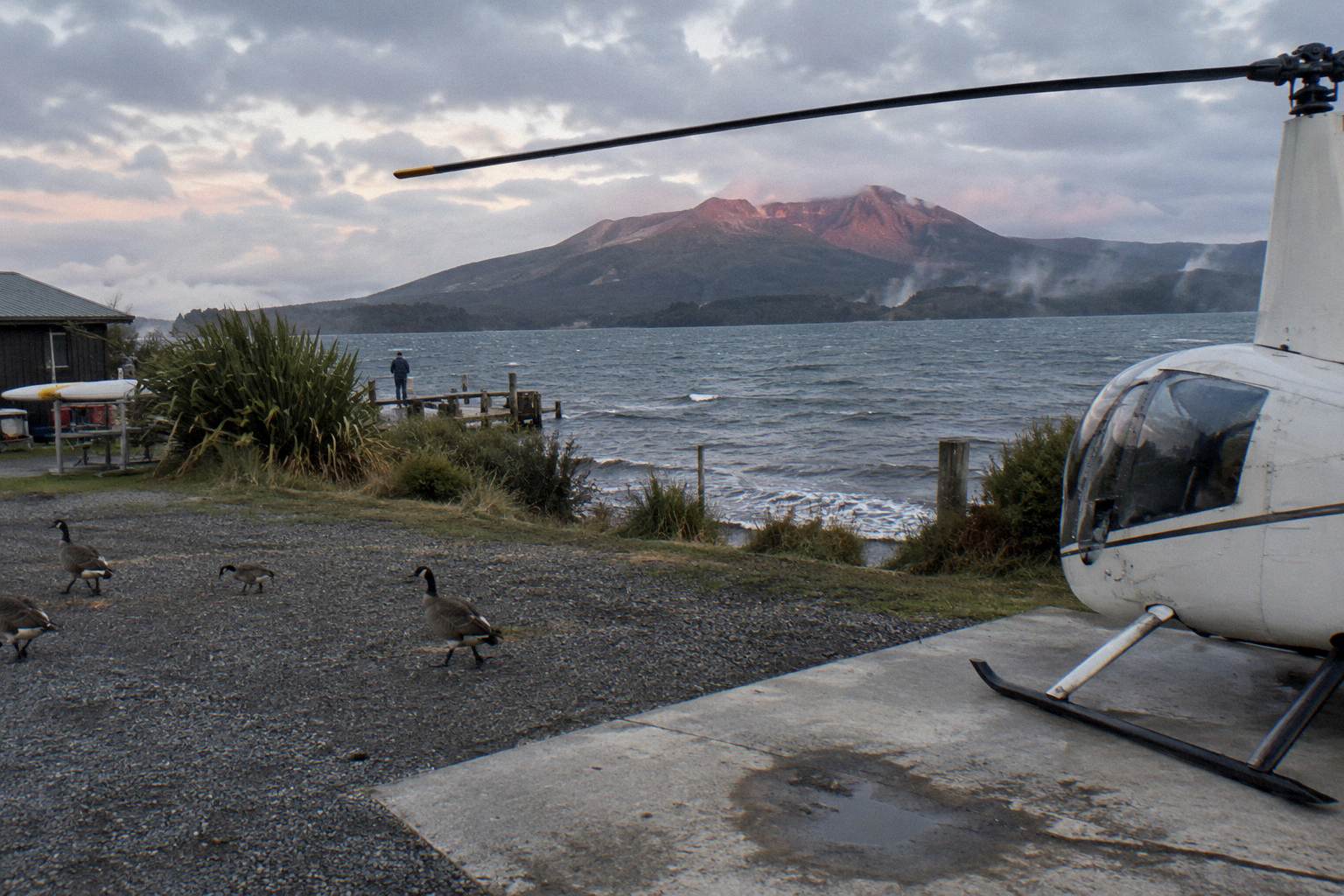
Weather deserves the widest margin in the plan. A landing flight can run but not land, since landings sit at the pilot's sole discretion, and a crater walk can be reshaped around the summit sections. The booking pages offer a full refund if the operator cancels for weather, and free cancellation up to 24 hours applies across all six tours, so an early booking costs little flexibility. The crater walk and landing weather guide works through what changes and when.
Season affects the pairing less than you might expect. Rotorua's town climate, measured at about 280 metres over 1991 to 2020, averages a mean daily maximum of 23.1 °C in February against 12.0 °C in July, with July the wettest month at 137.4 mm and November the driest at 86.8 mm. The summit at 1,111 metres is colder and windier than any town figure, so dress for the higher number's demands. The month-by-month guide takes the seasonal question in full.
One more pairing worth naming: the lake edge. The Tarawera Trail or Mt Tarawera crater walk comparison explains the DOC tramping track that runs 15 kilometres from the Te Wairoa car park to the Hot Water Beach campsite, an advanced track where dogs, bikes and vehicles are not permitted and where localised patches of sand are very hot, in DOC's words. It is a lake track, not the mountain, but it rounds out a multi-day Tarawera itinerary alongside Waimangu.
What The Dual Landing Adds To A Volcano-Focused Trip
The Tarawera And Orakei Korako Dual Landing Flight packages a helicopter flight, a landing and guided walk on Mt Tarawera, a ferry transfer and a 1-hour self-guided visit at Orakei Korako, admission shown as included, in about 3 hours, from NZ$1,490 per person. It visits Orakei Korako, not Waimangu, but it is the closest single booking to a two-geothermal-stop volcano day.
Think of it as the maximum-1886 ticket that does not involve walking uphill. You get the pilot's commentary over the volcanic landscape, the guided summit walk, and a second geothermal attraction reached by ferry rather than by road. The weight rule is 130 kg total per passenger on the booking page, the flight is not suitable for pregnant travellers, people with mobility impairments or people afraid of heights, a minimum of 2 adult fares applies, and infants sit on laps. Landing, as with every Volcanic Air flight, happens at the pilot's sole discretion.
Read the full details and dates on the Tarawera And Orakei Korako Dual Landing Flight page, and check availability once your day shape is set. Free cancellation up to 24 hours on the booking page gives room to move if the forecast turns.
The dual landing earns its slot in a Waimangu itinerary only if you accept that the valley is not on the ticket. Travellers who want both geothermal stops on the ground usually do better with a simpler mountain booking on one day and Waimangu on another. Travellers who want the most 1886 landscape per hour, with two landings and a summit walk and no driving, get it here. For a fuller look at the format, the helicopter landing and summit walk guide covers what changes between the 40-minute and 1-hour flights.
What The Volcano Is Doing Now, And Why That Matters For A Valley Visit
GeoNet publishes the current volcanic alert level for the Okataina Volcanic Centre, the caldera containing Tarawera, and that setting can change on any day, so check it before you travel. For a Waimangu pairing the practical read is that the valley's heat is geothermal rather than eruptive in character, while the mountain's domes are the solid record of older eruptions, and neither place is showing unrest at the level travellers would notice.
The distinction is worth two sentences because brochures blur it. The valley's pools and steam are a hydrothermal system the 1886 eruption created, in the operator's framing, and it expresses itself as heat and water, not as rising magma. The mountain's three domes, Ruawahia, Tarawera and Wahanga, with Ruawahia highest at 1,111 metres, are lava domes of the Okataina Volcanic Centre per the GNS fact sheet. Both stories are genuine volcanology; neither needs an eruption to be dramatic.
The 1886 numbers stay sobering regardless of current quiet. More than 100 people were killed in villages near the mountain, per GNS, and the eruption's sound reached Blenheim while its ash reached Christchurch. The count of lives lost in the Mount Tarawera eruption and the question of whether Mt Tarawera is still active both take those threads further, and the eruption date question settles the timeline.
Adjacent stops complete the 1886 circuit if time allows. The Buried Village of Te Wairoa at 1180 Tarawera Road is open 10am to 4pm Wednesday to Sunday, last entry 3.45pm, closed Monday, Tuesday and Christmas Day. DOC's Tarawera Trail page covers the lake-edge track, and Waimangu Volcanic Valley's own pages hold the current price and booking details for the tour.
Mistakes Visitors Make When Pairing Waimangu With The Mountain
The recurring errors: booking both on the same tight morning, expecting a tour that combines them on one ticket, assuming a flyover lands, treating the valley as a quick roadside stop, and trusting a single weather forecast for two very different outdoor experiences. Each mistake is avoidable with one decision made in the right order: book the mountain experience first, then shape the valley day around it.
The combined-ticket expectation fails most often. No tour in the six covered here visits Waimangu, and the dual landing's second stop is Orakei Korako. Once that is clear, the itinerary writes itself: a morning walk or flight, an afternoon in the valley, and no operator asked to do something it does not sell. The flyover assumption is the second trap; it is a fine product, but it is a flyover, no landing, and anyone who wants to stand on the summit should be sent to a landing flight or the guided walk every time.
The third mistake is underestimating the valley. Waimangu publishes no walk length anywhere read here, so treat it as a half-day attraction and check its own pages for the current tracks and times rather than assuming a 20-minute loop. The fourth is packing light on food. The crater walk provides no snacks, in the operator's own words, and a valley afternoon after a mountain morning burns whatever you carry. The what to wear and bring guide has the full kit list.
The fifth mistake is forgetting the evening. Mountain mornings start early, and a slow Rotorua evening rounds the day off well; rotoruaculturaldinner.com is the place to look for that. For everything else, the walk, 4WD or helicopter decision is the overview worth reading before you commit to a format.
Common Questions About Waimangu And Mt Tarawera
Is Waimangu Volcanic Valley Part Of The Mt Tarawera Tours?
No. Waimangu is a separate attraction at 587 Waimangu Road, and none of the six tours covered here visits it. The closest two-stop booking is the Tarawera And Orakei Korako Dual Landing Flight, which pairs a summit walk with Orakei Korako, a different geothermal attraction.
Can You Visit Waimangu And Do The Crater Walk On The Same Day?
Yes, if the mountain comes first. The Kaitiaki Half-Day 4WD And Crater Walk runs 4 hours 30 minutes and the 40-minute flight is shorter still, so either leaves an afternoon for the valley. Book the mountain for the morning and keep the valley unhurried.
Was Waimangu Really Created By The Tarawera Eruption?
The operator describes the valley's geothermal system as formed as a result of the volcanic eruption of 10 June 1886, the night GNS Science calls New Zealand's largest eruption during the last 500 years. The valley's heat is geothermal aftermath, not a second volcano.
Does Any Flight Land At Both Mt Tarawera And Waimangu?
No flight covered here lands at Waimangu. The floatplane flyover passes over Mt Tarawera and the volcanic landscape, per the operator's page, but it is flyover, no landing. Landings happen only on the mountain, at the pilot's sole discretion.
What Does The Dual Landing Flight Cost And Include?
From NZ$1,490 per person for about 3 hours: a helicopter flight, a landing and guided walk on Mt Tarawera, a ferry transfer to Orakei Korako and a 1-hour self-guided visit with admission shown as included. Free cancellation applies up to 24 hours on the booking page.
Do You Need A Guide For Mt Tarawera?
For the summit, the experiences covered here are guided, run by Kaitiaki Adventures and Volcanic Air, both concessionaires working alongside Ngati Rangitihi, whose Ruawahia 2B Trust governs the mountain. The lake-edge Tarawera Trail is a DOC tramping track and is a separate question, covered in its own guide.